B.5 Fran Coal Mine Case Study
Clinton County, PA
The mining team would like to acknowledge David Heinze of ENVIRON International Corporation who submitted the Biochemical Reactors Case Study.
B.5.1 Site Information
Contacts
Dave Fromell, PA DEP
(717) 7 83-5646
James J. Gusek
Sovereign Consulting, Inc.
12687 West Cedar Drive, Suite 305
Lakewood, Colorado 80228
720-524-4908
Joseph Schueck, PA DEP, BAMR
(717) 783-5633
B.5.2 Name, Location, and Site Description
The Fran Mine Site is a 15 ha (37 acre) reclaimed surface coal mine in Clinton county, PA. The area was partially mined in the 1930’s and additional coal recovery was undertaken between 1973 and 1977. Reportedly the “worst acid mine drainage (AMD)A low pH, metal-laden, sulfate-rich drainage originating from a mined area that occurs where sulfur or metal sulfides are exposed to atmospheric conditions. It forms under natural conditions from the oxidation of sulfide minerals and where the acidity exceeds the alkalinity. See also acid rock drainage. in the State of Pennsylvania”, destroying nearly 6 miles of three otherwise pristine streams which are tributaries of the Susquehanna River (Gusek and Schueck 2004).1 Buried pyrite-rich pit cleanings and tipple refuse were found to be producing severe AMDacid mine drainage. The pyritic material is located in discrete piles or pods in the backfill. The pods and the resulting contaminant plumes were initially defined using geophysical techniques and confirmed by drilling. Isolating the pyritic material from water and oxygen will prevent AMDacid mine drainage production (Schueck et al. 1996). The Fran Mine AMD is similar to acid rock drainage from metal mines in that it contains elevated concentrations of iron and aluminum as well as other heavy metals such as copper, zinc, cadmium, cobalt, chromium and nickel and has acidity on the order of grams per liter. Research has shown that AMDacid mine drainage with these similar characteristics is amenable to a passive treatment technology that uses sulfate reducing bacteria. The sulfate reducing bacteria is able to precipitate the heavy metals as sulfides and the aluminum as a hydroxy-sulfate mineral phase (Gusek and Schueck 2004)
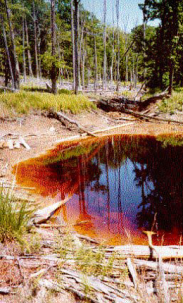
Figure B.5-1. Fran Coal Mine MIW
The lower Kittanning coal seam was present in two splits separated by 10 to 20 feet of clay. Only the upper split was mined, leaving a thick underclay as pavement. The coal was overlain by black shale capped by a sandstone unit. The black shale is thought to be pyritic and acid producing. Infiltrating precipitation is the only source of groundwater. Acidic discharges developed soon after reclamation and were first noted after a fish kill in 1978. The discharges to surface and underground, estimated to average 35 gpm, destroyed five miles of native trout streams. The operator was unable to maintain treatment facilities and forfeited $9,400 in bonds.
B.5.3 MIW Chemistry
Buried pyrite-rich pit cleanings and tipple refuse were found to be the source of the Fran AMDacid mine drainage in the pit backfill where the pyritic material was located in discrete piles or pods. These features and their resulting contaminant plumes were initially confirmed by drilling. The chemistry of the mine impacted waters (MIW) varies by season and is expressed below in Table B.5-1.
|
Date |
January 2002 |
April 2003 |
|---|---|---|
|
Parameter |
mg/L |
mg/L |
|
pH |
2.3 |
2.3 |
|
Aluminum |
343 |
221 |
|
Cobalt |
2.7 |
0.8 |
|
Cadmium |
0.11 |
<0.001 |
|
Copper |
1.8 |
0.56 |
|
Iron |
792 |
185 |
|
Sulfate |
4,963 |
2,140 |
|
Zinc |
6.4 |
2.0 |
|
Calculated Acidity |
4,370 |
2,060 |
Table B.5-2 lists pre-grouting water quality for the toe-of-spoil seep and selected monitoring wells which are considered to be representative of the site.2
The toe-of-spoil seep, labeled D3, and well FF62 represent the pre-grouting water quality which exits the site from the south and east lobes, respectively. Well FF62, located off site and adjacent to the east lobe, intercepts a subsurface discharge plume suspected to enter Rock Run as base flow. Also, well FF62 is located in the lower, unmined split of coal. The poor water quality demonstrates fracture communication between the pit floor and lower coal seam. D3 also appears to be coming from the lower coal seam. Comparison of the concentrations indicates that the water discharging from the east lobe (133) is of poorer quality than that discharging from the south lobe (FF62). Drainage from the majority of the pods of pyritic material flows towards the east lobe. Monitoring well L44 represents the pre-grouting water quality resulting from the Lower Kittanning spoil. L44 is not located downgradient of buried refuse or pit cleanings. Monitoring well L44 is considered a suitable control well to monitor normal water quality variations on the site because it is not influenced by the grouting activities. Flow from L44 would be toward the south lobe and eventually to the toe-of-spoil seep (Schueck et al. 1996).
|
|
Data |
|
|||||||||||||
|---|---|---|---|---|---|---|---|---|---|---|---|---|---|---|---|
|
Monitoring Point D3 – Toe-of-spoil seep area |
||||||||||||||
|
Lab |
TDS |
SO₄ |
Acid |
Fe Total |
Fe3+ |
Al |
Mn |
Cd |
Cu |
Cr |
Zn |
Temp |
|||
|
pH |
mg/L |
mg/L |
mg/L |
mg/L |
mg/L |
mg/L |
mg/L |
µg/L |
µg/L |
µg/L |
µg/L |
Deg. C |
|||
|
2.49 |
6,475 |
2,571 |
2,995 |
321 |
254 |
268 |
48.3 |
25.5 |
612 |
200 |
3.4 |
n/d |
|||
|
Monitoring Well FF62 – East Lobe – Groundwater Discharge Point |
|||||||||||||||
|
2.32 |
7,970 |
3,477 |
4,088 |
876 |
737 |
256 |
39.2 |
83 |
806 |
221 |
4.3 |
12.0 |
|||
|
Monitoring Well L44 – Lower Kittanning Spoil |
|||||||||||||||
|
2.47 |
7,920 |
2,958 |
3,828 |
747 |
598 |
236 |
48.1 |
111 |
751 |
163 |
6.8 |
12.9 |
|||
|
Monitoring Well K23 – Severe AMD Production in Pods |
|||||||||||||||
|
2.1 |
46,352 |
15,639 |
21,315 |
5,437 |
1200 |
1,515 |
60.5 |
610 |
5,950 |
1108 |
27.6 |
13.3 |
|||
|
Monitoring Well X48 – Combined Spoil and Pyritic Pods |
|||||||||||||||
|
2.37 |
1,408 |
6,991 |
7,470 |
1,707 |
439 |
492 |
72.8 |
227 |
2,543 |
559 |
8.7 |
12.7 |
|||
Monitoring well K23 demonstrates that the pods of refuse or pit cleanings can be sources of severe, localized AMD production. Concentrations of the mine drainage parameters in the water in and adjacent to these piles are often several times greater than the concentration of the same parameters in the discharge or elsewhere on the site. K23 is located within a pile of buried tipple refuse. It is located on the up-dip portion of the mine site and is also at the upper end of a pollution plume as defined by EM. The mean concentrations of the AMDacid mine drainage parameters at K23 are four to six times greater than the concentrations of the same parameters in L44, which represents AMDacid mine drainage generated by the spoil alone. This implies that enhanced AMDacid mine drainage production from the pyritic material at K23 and similar locations significantly contribute to the degradation of the final discharge quality. The isolation of these subsurface pods of pyritic material from water and/or oxygen should improve the final discharge quality. This was the premise for this research effort.
Monitoring well X48 is located several hundred feet downgradient of piles of pyritic material, but is within the flow path of mine drainage as it migrates through the site towards the east lobe. The water quality sampled from this well would be influenced by both the Lower Kittanning spoil as well as AMDacid mine drainage formed in the buried pods of pyritic materials. Note that the mean concentrations of the mine drainage parameters in well X48 are about double the mean concentrations of L44. X48 indicates dilution of the severe AMD as it migrates and mixes with less severe mine drainage. (Schueck et al. 1996)
Certain trace metals also contribute to the pollution from this site. Elevated concentrations of zinc, copper, chromium, cadmium, and arsenic were common in the drainage from this site. The concentrations of other trace metals, such as lead, nickel, and selenium were generally below detection limits
B.5.4 System Design
Because of the MIW chemistry, limestone-dominated vertical floor reactor cells were deemed inappropriate. This assumption was based primarily on the aluminum concentrations, vertical floor reactor systems plug with aluminum hydroxide (gibbsite) if the AMD contains more than 5-7 mg/L of dissolved aluminum unless a flushing feature is included in the design Gusek and Schueck 2004).
Properly designed sulfate reducing bioreactors do not suffer from the same limitations as vertical floor reactor systems. The SRBR design process typically involves bench scale tests to select the best organic substrateEither (a) a chemical which reacts or (b) a solid surface or (c) an electron donor. mixture followed by a longer pilot test to evaluate the concept under field conditions.
In 1992 and 1993, a grout injection program to isolate the pyritic material from water and oxygen and thus prevent AMDacid mine drainage production was completed. The grout, composed of fluidized bed combustion (FBC) ash and water, was used in two different approaches that attempted pyrite isolation (Gusek and Schueck 2004).
Statistically significant water quality improvements have been noted as a result of the grouting, although resulted have varied. Any water quality improvements resulting from the grouting are expected to be permanent because of the nature of the cementitious grout. However, the grouting program did not solve all AMD problems at the site. Residual AMDacid mine drainage seepage from one zone of the backfilled pit continued to be problematic (Schueck et al. 1996).
A preliminary design for a full scale system used data from the winter of 2002-2003 which was reported as one of the wettest in recent memory in Pennsylvania. Anecdotal data suggest that the design peak flow rate for the full scale system would be about 30 gpm. Spot flow measurements in March 2003 revealed a flow rate of 82 gpm from the holding pond. A week later, the flow had reportedly dropped to 42 gpm. The size of the full scale system will be a function of assumed design flow rate. Absent more frequent flow data, it was assumed that the design flow will be 42 gpm and that any amount above that value will bypass the system and mix with the treated effluent with its buffering alkalinity. Flow rates about 42 gpm will be short lived, on the order of two weeks and that impacts to downstream locations will be mitigated by dilution with the elevated flows in the watershed in general.
The full scale system was planned to be comprised of the following components:
- A pipeline drain penetrating the pit boundary subcrop of the coal seam to divert AMDacid mine drainage to the treatment system
- Four covered/buried sulfate reducing bioreactors plumbed in parallel
- An aerobic polishing cellAn individual unit in a treatment system. discharging into an existing channel that feeds Camp Run.
Replacement of the organic substrate every 20 years was expected.
B.5.5 BCR Performance
On August 2001, five bench-scale SRBR cells were assembled on Pennsylvania State Forest maintenance facility on Cook’s Run. The five various bench cell construction materials are summarized below:
- chipped wood (8-40 percent by weight)
- sawdust (10-40 percent)
- limestone (30 percent in all cells)
- alfalfa Hay (10 percent in all cells)
- cow manure (10 percent in all cells)
- cement kiln dust (1 percent in all cells, except #3)
|
Cell 1 |
Cell 2 |
Cell 3 |
Cell 4 |
Cell 5 |
|
|---|---|---|---|---|---|
|
Wood Chips |
10% |
25% |
25% |
40% |
8% |
|
Sawdust |
40% |
25% |
25% |
10% |
21% |
|
Limestone |
29% |
29% |
30% |
29% |
50% |
|
Alfalfa Hay |
10% |
10% |
10% |
10% |
10% |
|
Cement Kiln Dust |
1% |
1% |
0% |
1% |
1% |
|
Manure |
10% |
10% |
10% |
10% |
10% |
|
Logic |
High Sawdust |
Baseline |
No Kiln Dust |
High Wood Chips |
High Limestone |
The bench scale tests used 40 gallon capacity bench cells that were arranged in parallel to receive untreated Fran Mine water delivered by individual ISCO battery-powered automatic samplers, drawing form a common source tank that was replenished on a bi-weekly schedule. The cells operated for 18 weeks, then all cells were subjected to an autopsy to evaluate how much, if any, plugging occurred due to the precipitation of metal sulfides and other metallic compounds during the test period (Gusek and Schueck 2004).1
Prior to dissecting the bench cells, sample aliquots were recovered from the feed water holding tank and the discharge pipes and submitted for total metals analysis. The results are presented in Table 4.
Note the marked decrease in silicon, from about 77 mg/L in the feed water (average of 68 and 85 mg/L) to about 7 mg/L in the Cell 4 effluent. This reduction suggests that silicate-based metal compounds, perhaps higher density alumino-silicates, might be forming in the substrate in lieu of the typical gibbsite which is so problematic in many SAPSsuccessive alkalinity producing systems and other limestone-based passive treatment systems (Gusek and Schueck 2004).
|
Parameter |
Feed |
Bench 2 |
Bench 4 |
Bench 5 |
|---|---|---|---|---|
|
Aluminum |
305 |
0.11 |
BDL |
0.09 |
|
Cadmium |
0.10 |
0.01 |
0.00 |
0.03 |
|
Cobalt |
2.10 |
0.06 |
0.02 |
0.26 |
|
Chromium |
0.16 |
BDL |
BDL |
0.01 |
|
Copper |
1.61 |
BDL |
0.01 |
BDL |
|
Iron |
709 |
38.10 |
0.66 |
94.21 |
|
Manganese |
79 |
33 |
2.9 |
38 |
|
Nickel |
2.93 |
0.03 |
0.04 |
0.28 |
|
Sulfate calculated |
4,480 |
1,400 |
180 |
1,250 |
|
Silicon |
67 |
11 |
7 |
42 |
|
Zinc |
5.75 |
0.02 |
0.05 |
0.10 |
Based on metal removal data, it appeared that the substrate mixture in Cell 4 was slightly superior to the mixtures in Cells 1, 2, and 3, and clearly superior to the high limestone mixture in Cell 5 (Gusek and Schueck 2004).
The autopsies of the cells did not reveal any visible accumulations of aluminum precipitate, typically observed as a gel-like mass. The effluent pipe and limestone drainage layers were typically clean. Unfortunately, the cells were frozen, so it was not possible to closely examine the substrate for traces of aluminum deposits. Regardless, all cells operated from August to late December without any need for flushing to maintain flows. This is an advantage when looking from a maintenance standpoint at a remote mine location (Gusek and Schueck 2004).
Subsequently, PA DEP decided to install a 550-foot long underground drain to divert water away from the site. To neutralize the pH of any groundwater or rainwater that does flow through the site, 15,000 tons of alkaline material was to be packed into the ground. The agency planned to seed 27 acres, plant more than 15,000 trees, construct an access road and excavate and backfill 165,000 cubic yards of soil and material from the site (Spadoni 2012).
B.5.6 References
Gusek, J.J. and Schueck, J. 2004. Bench and Pilot Scale Test Results Passive Treatment of Acid Mine Drainage (AMD) at the Fran Coal Mine, PA.
Schueck, Joesph, Mike DiMatteo, Barry Scheetz, and Mike Silsbee. 1996 "Water Quality Improvements Resulting from FBC Ash Grouting of Buried Piles of Pyritic Materials on a Surface Coal Mine." Annual Meeting of the West Virginia Acid Mine Drainage Task Force
Spadoni, D. 2012. DEP Awards More than $650,000 for Mine Reclamation Work in Clinton County. Pennsylvania Department of Environmental Protection.
Publication Date: November 2013